


Business leadership roles are changing as automation, data-driven decision-making and digitally enabled teams become standard across industries. For Master of Business Administration (MBA) students and graduates, staying competitive now depends on how well graduate programs develop adaptable leaders who can apply data and technology in real-world settings.
To better understand these expectations, a questionnaire was conducted on behalf of Arkansas State University (A-State) among 151 current MBA students and recent graduates within the past five years. The questionnaire explored which skills respondents viewed as most critical for workforce readiness and how effectively MBA programs balanced traditional business fundamentals with emerging topics such as AI literacy and digital strategy.
Key Takeaways
- Adaptability (61%) and data literacy (47%) top the list of skills MBA students and grads say are most critical for future career success.
- 40% are confident they could lead a team that includes AI-powered workflows.
- MBA students and grads said just over half of their MBA coursework (53%) feels directly applicable to their day-to-day work.
- 45% of MBA students and grads are very likely to recommend their MBA program to someone who wants to lead in an AI economy.
Skills MBAs Say Matter Most in a Tech-enabled Workplace
The modern workplace requires leaders who can adjust quickly while still grounding decisions in solid business fundamentals. MBA students and graduates view adaptability and data awareness as essential leadership traits rather than optional enhancements.
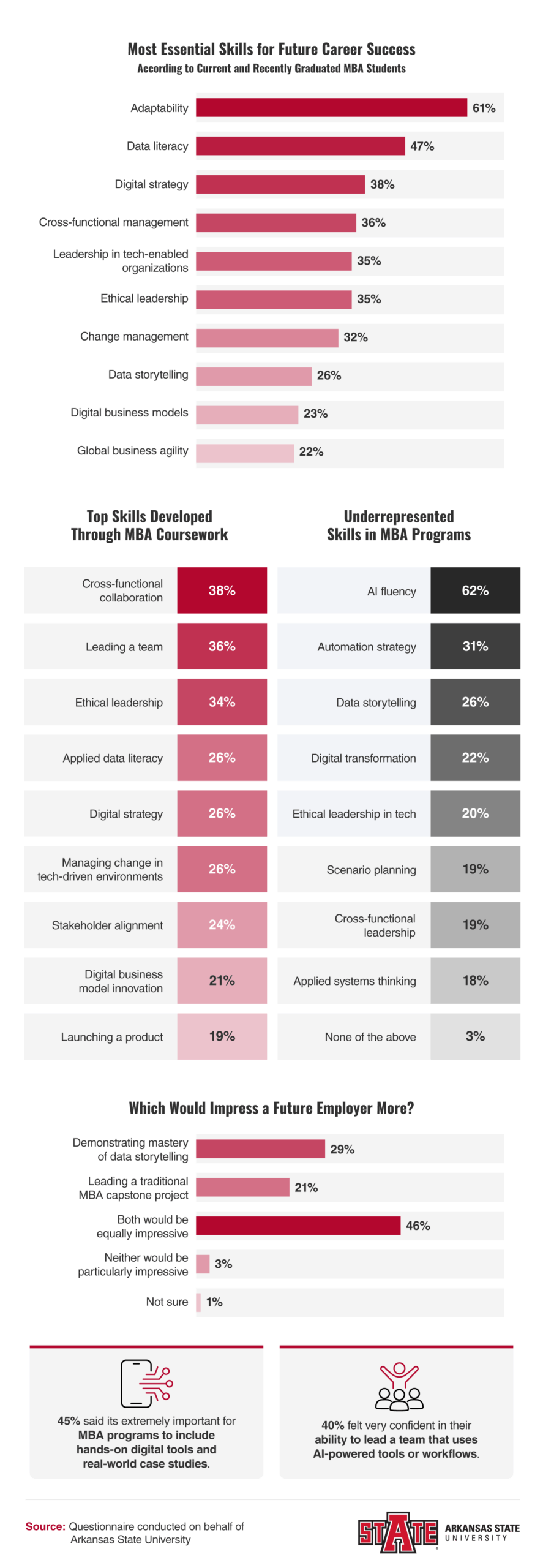
However, there’s a notable gap in AI preparation. While 45% of respondents said it’s highly important for MBA programs to include real-world digital tools, only 40% felt confident leading teams that included AI-powered workflows. Even more striking, 62% reported that AI fluency was underrepresented in their MBA programs.
That said, traditional leadership development remained a strength. Respondents noted that MBA programs performed well in areas such as cross-functional collaboration (38%), team leadership (36%) and ethical leadership (34%).
Balancing Business Fundamentals With Modern Skill Development
MBA curricula have long emphasized finance, operations and strategy, but students increasingly expect programs to integrate contemporary topics without sacrificing core business knowledge. Achieving that balance remains a central challenge.
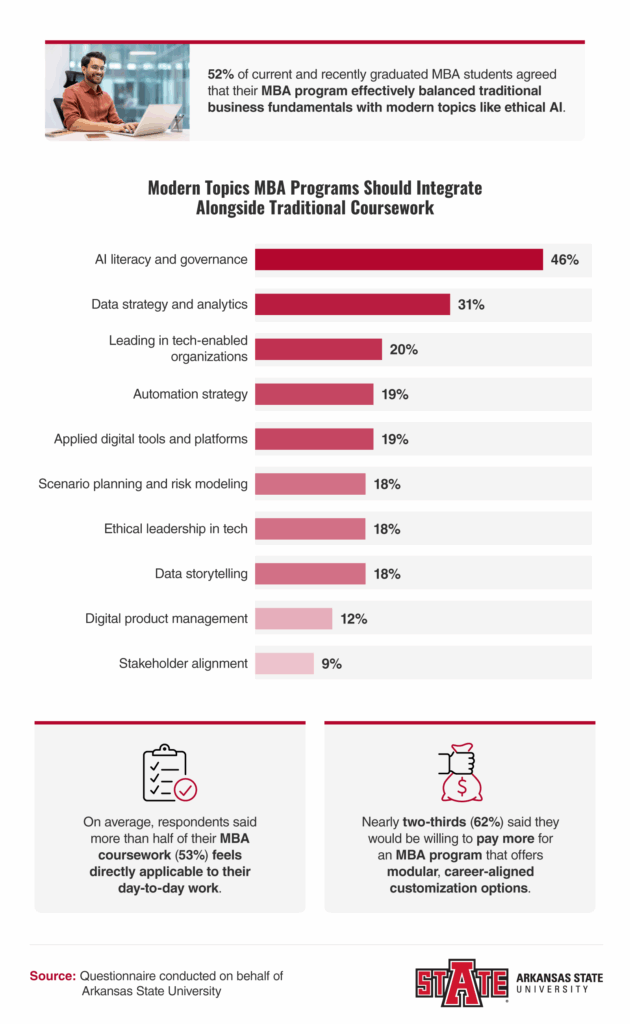
Just over half of respondents (52%) said their MBA program effectively balanced traditional business fundamentals with modern topics such as ethical AI. When asked which modern skills should be prioritized, 46% identified AI literacy and governance as the most critical area to integrate into MBA curricula. Data strategy and analytics (31%) were the next most frequently mentioned, followed by leading in tech-enabled organizations (20%).
The bigger concern may be relevance. Respondents reported that only 53% of their MBA coursework felt directly applicable to day-to-day job responsibilities. This gap between the classroom and the workplace helps explain why nearly two-thirds (62%) said they would pay more for modular, career-aligned MBA programs that offer flexible structures tied closely to professional outcomes.
How Career Goals Shape MBA Program Perceptions
Career advancement remains a primary motivator for pursuing an MBA, but students are increasingly selective about which program attributes matter most to them. Practical readiness and flexibility now outweigh traditional prestige factors for many learners.
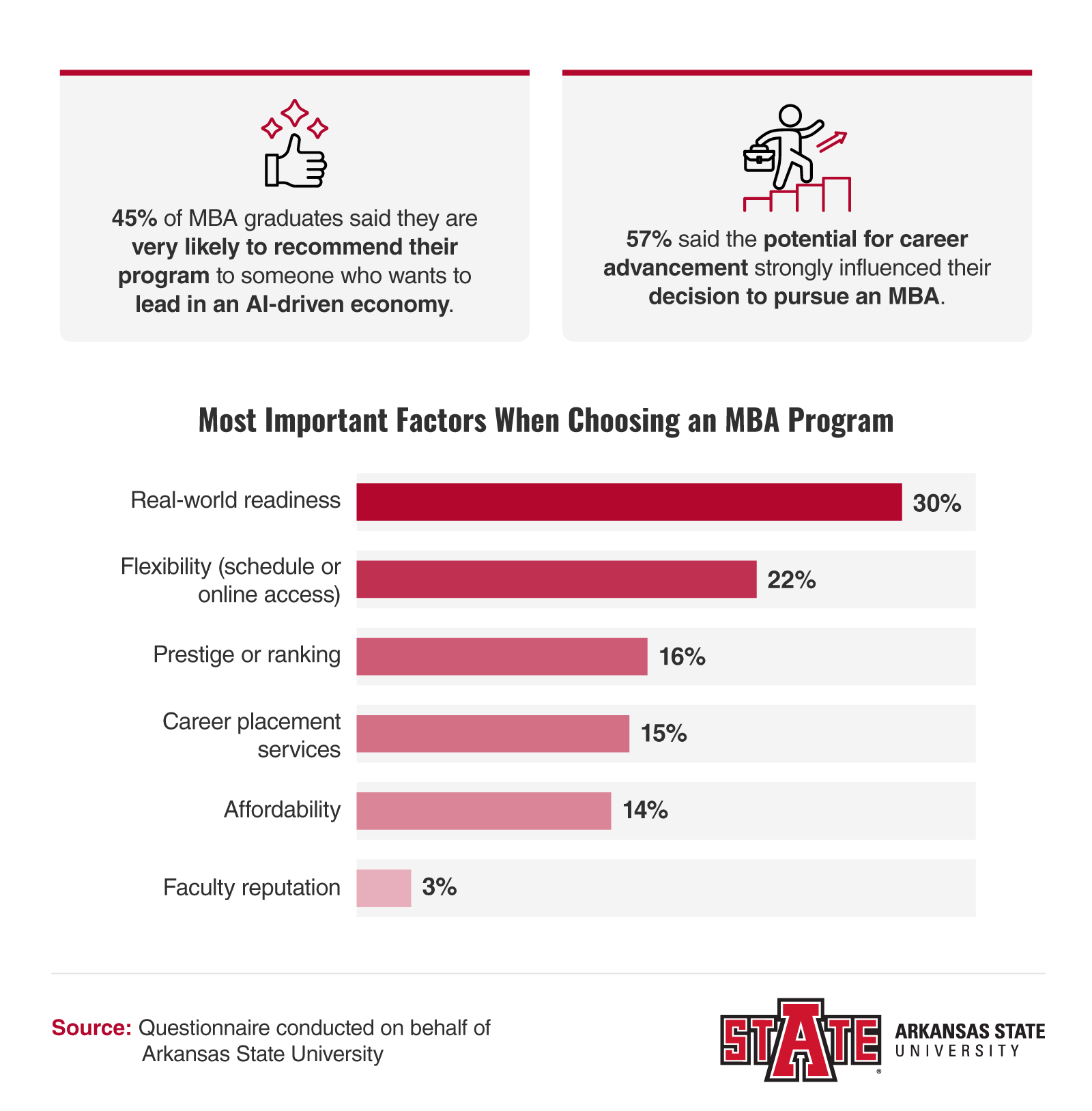
More than half of respondents (57%) said career advancement heavily influenced their decision to pursue an MBA. When evaluating programs, real-world readiness ranked highest, at 30%, followed by flexibility (22%). Prestige or rankings lagged at 16%, suggesting that working professionals prioritize fit and applicability over reputation.
Satisfaction levels with MBA programs reveal room for improvement. Only 45% of MBA students or graduates said they were very likely to recommend their program to someone who wants to lead in an AI economy, a notable gap given that career advancement is the driving force behind most MBA decisions.
Preparing MBA Graduates for a Rapidly Evolving Workplace
For prospective MBA students, these findings highlight the importance of evaluating programs not just on reputation but also on how well they prepare you for the realities of today’s workplace. As AI and digital tools reshape business leadership, look for curricula that explicitly address data literacy, AI governance and hands-on experience with tech-enabled workflows. The right MBA program teaches business fundamentals but also equips you to lead confidently in an economy where adaptability and technological fluency are no longer optional.
Methodology
This study was based on a questionnaire of 151 respondents who were either currently enrolled in a Master of Business Administration program or had graduated within the past five years. The questionnaire was conducted on behalf of Arkansas State University and explored perceptions of skill relevance, curriculum balance and career outcomes related to MBA education. The findings reflect self-reported perceptions from a convenience sample and may not represent all MBA students or graduates. Geographic distribution, program type and industry representation were not controlled for in the analysis.
About Arkansas State University
Arkansas State University Online offers flexible graduate programs designed for working professionals seeking career advancement. A-State’s online MBA programs emphasize leadership development, strategic thinking and practical business skills that align with today’s evolving workplace. Delivered in an online format, the programs support students balancing professional and personal responsibilities.
Fair Use Statement
The information in this article may be used for noncommercial purposes only. When sharing or citing this content, proper attribution with a link to Arkansas State University is required.