

AI is transforming the way work is done across industries, from chatbots to generative artificial intelligence tools and algorithms that streamline daily tasks. For learners preparing to enter today’s workforce, it’s essential to understand how AI impacts hiring decisions, job readiness and long-term professional development. Higher education institutions face growing pressure to ensure student learning keeps pace with advancements in AI technologies while supporting critical thinking, academic integrity and data privacy.
To better understand this shift, a questionnaire was conducted on behalf of Arkansas State University (A-State). Participants in this questionnaire included current college students and employers who recently hired graduates. The research explores how individual students use AI tools and how these experiences compare to employer expectations in AI-driven workplaces.
This research aimed to gain insight into AI literacy across academic and professional settings. The study uncovered gaps between confidence and preparation, differences across majors and industries, and evolving expectations around the use of AI systems at work. The results offer students and educators a snapshot of AI’s impact on learning experiences and early career readiness today.
Key Takeaways
- While 56% of students feel highly confident about using AI in their future careers, just 14% believe their school is ahead in preparing students to use AI.
- Only 20% of college students said a professor has taught them how to write effective AI prompts.
- 26% of employers said entry-level hires don’t meet expectations, and 31% have already had to retrain new graduates due to AI skill gaps.
- Nearly one in five employers (18%) said they’ve passed on a candidate due to a lack of AI-related skills.
- While 85% of students use ChatGPT and 81% of employers say it’s most relevant, employers place far more value on tools like Microsoft Copilot (48%) and AI-integrated CRMs (22%) than students actually use.
Student Confidence and AI Use Across Majors
College students interact with artificial intelligence in many ways, from brainstorming ideas to using AI-generated content during the learning process. In some majors, AI also supports personalized learning by helping students tailor study materials, lesson planning or coursework to their needs.
Confidence in using AI tools, however, varies by academic discipline and by how AI in education is introduced in courses. Understanding these differences helps clarify where preparation feels strongest and where gaps remain.
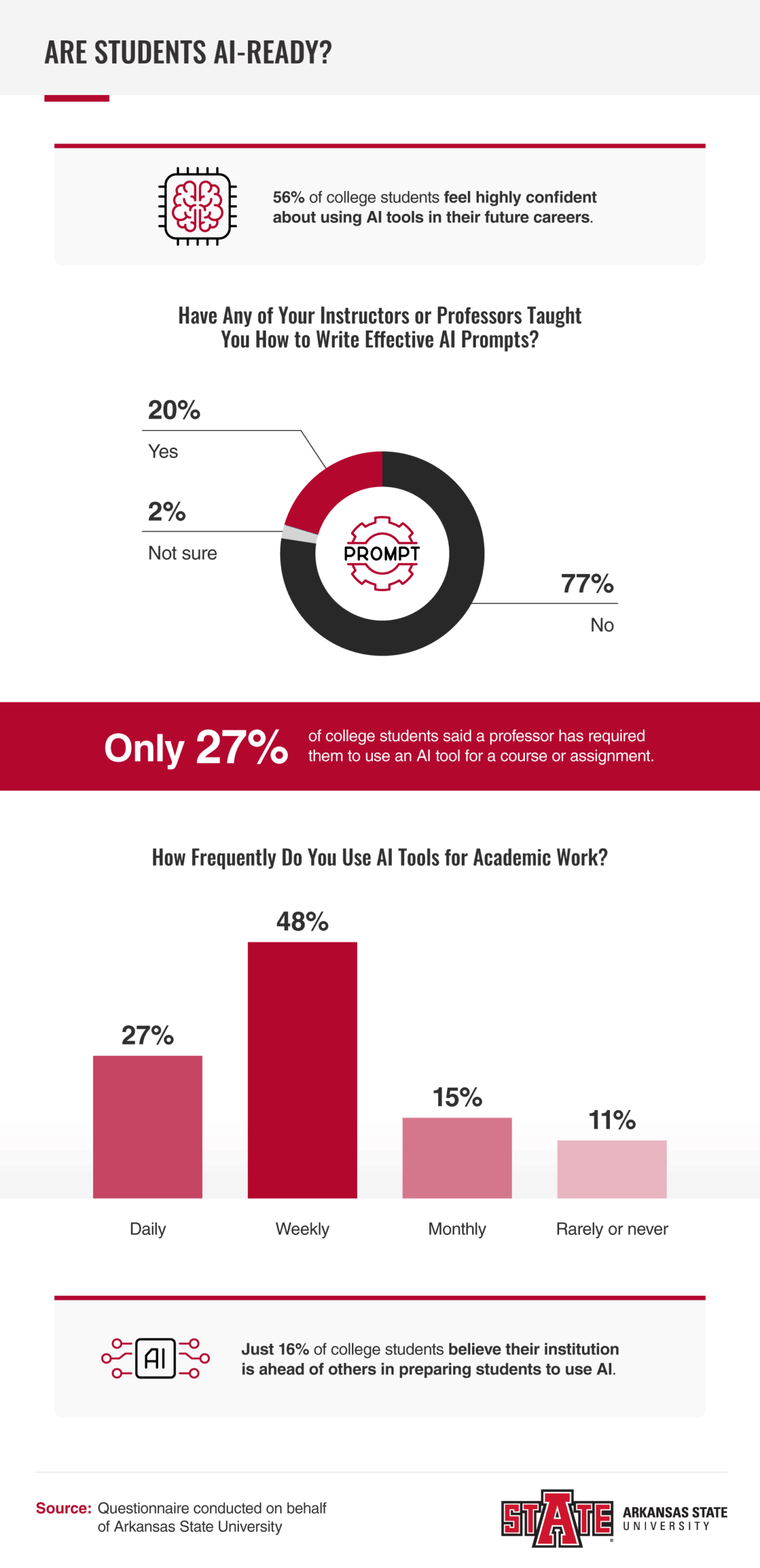
Three in four college students reported using AI for academic work on a daily or weekly basis. Education students led the way in frequency, with 86% using AI weekly or daily, followed by health sciences students (83%) and technology students (74%).
Only 56% of students felt highly confident about using AI in their future careers. Confidence levels were highest among students in education (71%), technology (68%) and engineering (64%), and lowest among those in healthcare (46%).
Instructional support remains limited. Only 20% of college students said that a professor has taught them how to write effective AI prompts, and just 14% believe their school is ahead in preparing learners to use AI in the workforce. Without guidance, learners may struggle to understand how best to use AI and how to avoid negative impacts, such as plagiarism, discrimination and errors.
Tips for Students
Confidence with AI often comes from hands-on experience and instruction. If you want to feel more prepared, look for classes, projects or internships that use AI tools in assignments. Taking the initiative to practice AI skills can help close gaps in preparation.
Employer Expectations and AI Skill Gaps
As AI-driven tools become embedded in daily workflows, employers increasingly expect new hires to arrive with practical AI literacy. Organizations are adjusting their policies, training and hiring practices in response to the rapid automation and adoption of generative AI.
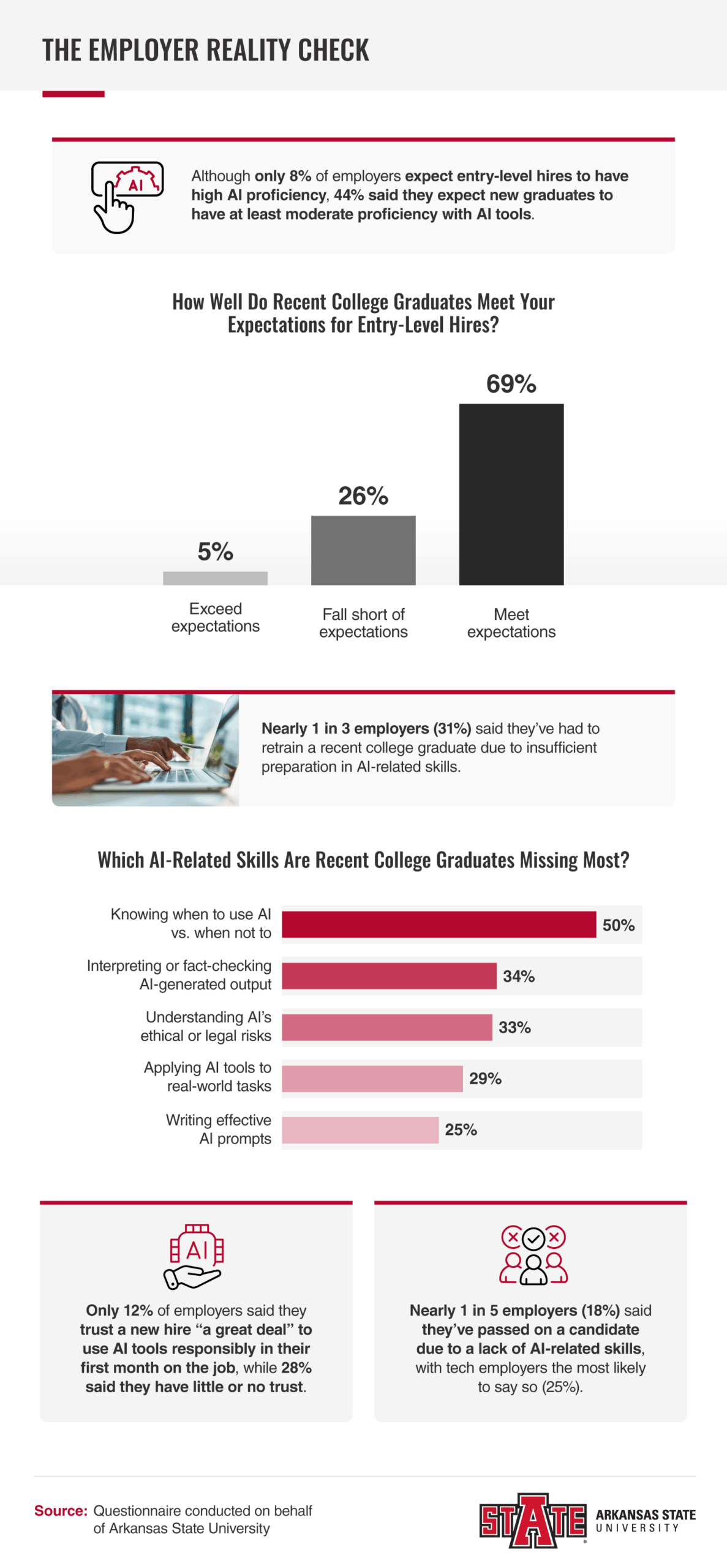
Nearly one in five employers (18%) had passed on a candidate because of insufficient AI-related skills, and 26% said that entry-level hires did not meet expectations. Overall, 31% of employers said they had to retrain recent graduates due to gaps in AI skills. Retraining was most common in marketing or advertising at 41%, followed by technology (35%).
Employers also described challenges in managing the use of AI at work. Sixty percent said they have to limit or restrict how employees use AI tools. The most cited reasons included:
- Compliance or legal risks (30%)
- Privacy or security concerns (29%)
- Accuracy or data hallucination issues (19%)
- Lack of training or guidance (17%)
Tips for Students
Many employers expect new hires to arrive with basic AI skills and an understanding of how to use them responsibly. You can prepare by learning how AI is applied in your field and by practicing tasks like research, analysis or content creation with AI tools. Understanding workplace rules around accuracy, privacy and ethics is also important.
The Disconnect Between Popular Tools and Workplace Needs
Not all AI tools carry equal value in academic and professional settings. While students often gravitate toward widely known platforms, employers more often prioritize tools embedded within business systems and workflows.
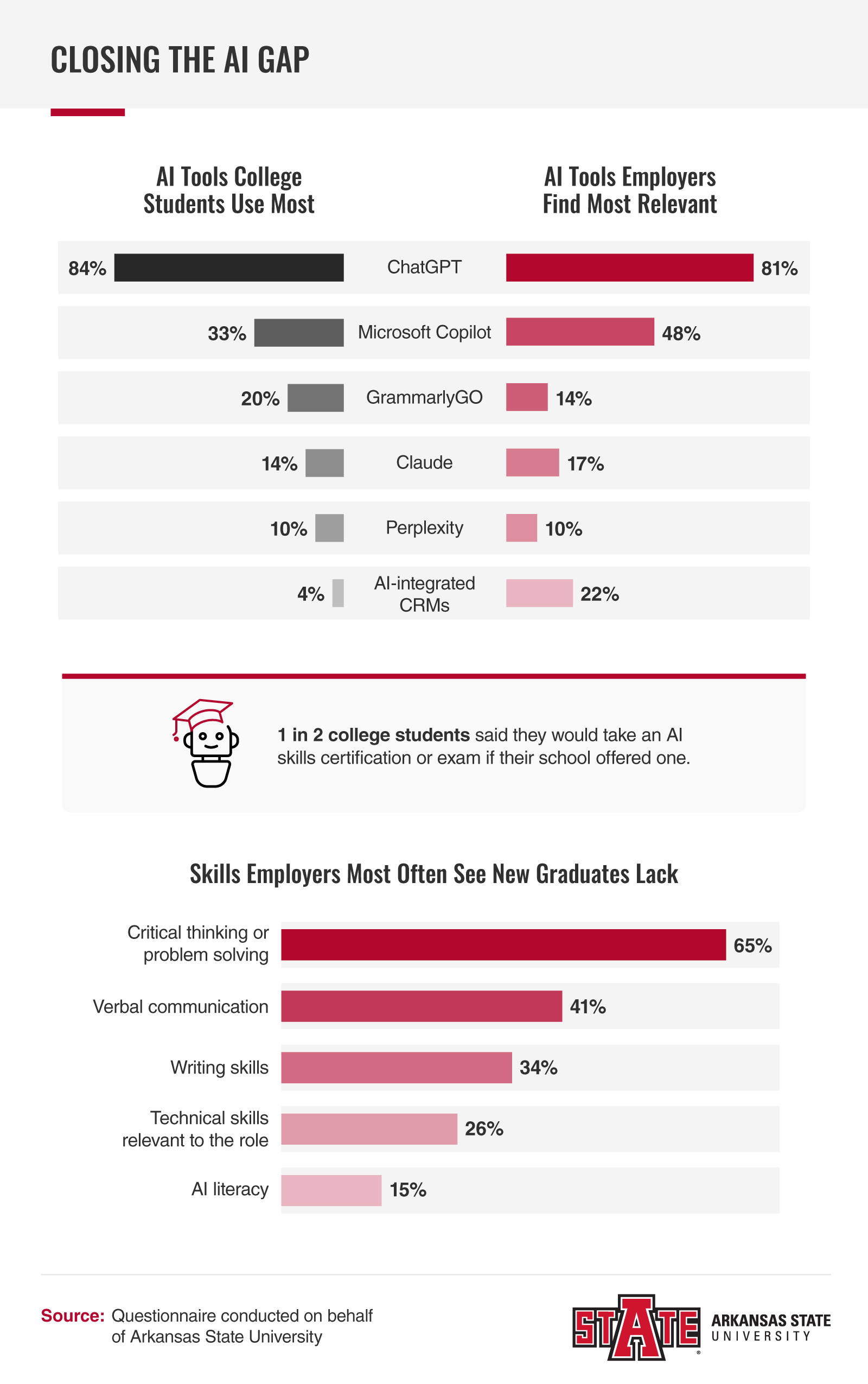
Most students (85%) reported using ChatGPT, and 81% of employers viewed it as the most relevant tool. ChatGPT also emerged as the most relevant AI tool across every industry surveyed, with 75% to 85% of employers in each sector identifying it as relevant, well ahead of Microsoft Copilot.
However, there is a disconnect between students and employers regarding Copilot. About half of employers (48%) found it to be valuable, while only 33% of students have used it. Another gap exists between the percentage of employers who value AI-integrated CRMs (22%) and the percentage of students who use them (4%).
Tips for Students
Popular tools like ChatGPT are useful, but they are not the only tools employers care about. You can benefit from learning how AI works inside common workplace software, such as productivity tools or customer management systems. Exploring these tools early can make the transition from school to work easier.
Preparing Learners for an AI-driven Future
Artificial intelligence is already part of how many students learn, study and complete everyday tasks, yet feeling ready to use those tools at work remains a different challenge. Classroom exposure to AI varies widely, and employer expectations continue to shift as AI-powered systems become more common across roles and industries. This mismatch can leave students unsure of how their current habits translate into real workplace skills.
Students who want to be better prepared can take small, intentional steps. Paying attention to how AI tools are used in a chosen field, practicing fact-checking AI-generated content and strengthening critical thinking skills can make a meaningful difference. As AI continues to influence careers and learning environments, staying curious and informed can help you move forward with greater confidence.
Methodology
On behalf of Arkansas State University, this study surveyed 319 college students and 438 employers who have hired recent college graduates within the past two years to explore AI readiness in academic and workplace settings. Data was collected in December 2025. The findings reflect a non-scientific, exploratory study and are not intended to be nationally representative of all college students or employers.
About Arkansas State University
Arkansas State University offers flexible online undergraduate programs designed to support learners balancing education with work and personal commitments. These programs emphasize practical skills, critical thinking and real-world applications across disciplines. Learn more about A-State’s online undergraduate programs today.
Fair Use Statement
The information in this article may be used for noncommercial purposes only. If shared or referenced, proper attribution with a link back to Arkansas State University must be included.