


Obtaining a Master of Social Work is a powerful step forward for professionals seeking leadership, clinical or specialized roles in social work practice. Whether your goal is to serve in mental health, human services or healthcare, this graduate degree expands your ability to make a difference while increasing your qualifications.
An MSW builds on the foundation of a Bachelor of Social Work (BSW) by deepening your understanding of social welfare, mental health and advocacy. Graduates gain access to higher-level roles, improved salary potential and advanced licensure eligibility.
Earning a CSWE-accredited MSW from a flexible online MSW program — like the Online Master of Social Work programs at Arkansas State University (A-State) — prepares you to lead, support communities and create lasting change. This article covers what the degree involves, how it supports your career, available financial aid and why A-State’s MSW program stands out among graduate programs in social work.

What Is a Master’s in Social Work?
A Master of Social Work (MSW) is a graduate-level degree program designed for those who want advanced roles in the social work profession. The curriculum combines core coursework, field education and electives in areas such as advocacy, human behavior and social justice. Many programs also offer specialization tracks to align with students’ career goals.
To ensure quality and licensure readiness, MSW programs should be CSWE-accredited. The Council on Social Work Education sets national standards that help ensure consistent, high-quality preparation across institutions.
Most MSW programs offer advanced standing options for students with a BSW, allowing them to complete their credit hours more quickly. Whether you’re pursuing a full-time or part-time path, flexible formats — including online learning — make it easier to balance academics with work or family responsibilities.
For example, Arkansas State University offers a fully online MSW that meets CSWE standards while providing personalized faculty support and real-world field placements. The program accepts students with a bachelor’s degree in social work or a related field and considers GPA and work experience during the admissions process.
Is a Master’s in Social Work Worth It?
For those committed to the social work profession, earning a Master of Social Work can be a valuable investment in career advancement and personal growth. An MSW supports access to leadership positions, broader job options and eligibility for clinical licensure, which is a requirement for direct interventions in clinical social work.
Job prospects in this field are strong. The Bureau of Labor Statistics projects 6% job growth for social workers between 2024 and 2034, with roles in healthcare and behavioral health in steady demand. This demand reflects rising needs in mental health, aging populations and human services.
An MSW also improves earning potential. According to the BLS, the median annual salary for social workers is $61,330. However, the National Association of Social Workers (NASW) reports that MSW graduates earn an additional $13,000 or more per year compared to BSW graduates.
Beyond salary, MSW graduates enjoy greater career mobility, satisfaction from promoting social justice and the opportunity to make a lasting community impact. With the added benefit of financial aid options, pursuing an MSW offers both personal and professional rewards.
MSW Career Opportunities
Professionals who earn a Master of Social Work often find career opportunities across direct practice, policy and administration. With an MSW, you can engage in hands‑on social work practice, shape program leadership or influence policy and community development. Each of these pathways draws on the advanced skills and knowledge you gain in the program.
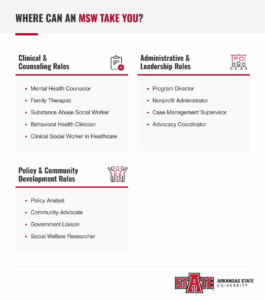
Clinical and Counseling Roles
MSW graduates who go on to obtain LCSW licensure are well‑positioned for clinical social work, therapy and mental health services roles. This licensure is a requirement for clinical practice and direct interventions. Coursework in human behavior, interventions, evidence‑based practice and social work equips graduates to meet licensure requirements. With an LCSW, professionals may pursue roles such as:
- Mental health counselor
- Family therapist
- Substance abuse social worker
- Behavioral health clinician
- Clinical social worker in healthcare
Administrative and Leadership Roles
In leadership and administrative positions, MSW degree holders manage programs, supervise teams and guide service delivery across non-profit and public health organizations. These roles require management skills, evidence-based decision-making and cross-sector collaboration. Potential roles include:
- Program director
- Nonprofit administrator
- Case management supervisor
- Advocacy coordinator
These administrative and leadership roles typically do not require clinical licensure, although some supervisory positions may prefer or require it depending on the employer or setting.
Policy and Community Development Roles
MSW professionals also work in policy and advocacy, shaping systems through research, legislative efforts and community development. These roles aim to promote human rights, strengthen the social environment and improve social welfare systems through evidence-based approaches. Career examples include:
- Policy analyst
- Community advocate
- Government liaison
- Social welfare researcher
7 Ways an MSW Advances Your Career
It pays to start thinking about your long‑term goals early when pursuing an MSW. Knowing what you’re working toward can boost motivation and help improve completion rates in the program. Here are several ways an MSW supports career growth and professional development:
- Qualify for clinical licensure (LCSW): Earning an MSW is a required step toward becoming a licensed clinical social worker, but you must also meet state licensure requirements to engage in independent clinical practice and direct care roles.
- Advance to supervisory and leadership positions: With the advanced competencies from the MSW, you’re eligible for roles like program director or case management supervisor in human services and non-profit settings.
- Specialize in high‑demand fields like healthcare, child welfare or behavioral health: MSW graduates can focus on areas where job growth is strong, such as mental health or substance abuse services.
- Increase earning potential and long‑term job stability: Data show that most licensed social workers hold advanced degrees, which often correlates with higher median earnings.
- Develop advanced competencies, social work practice skills and real-world experience: The MSW curriculum typically incorporates coursework in human behavior, evidence-based interventions and field education, building stronger professional skills.
- Strengthen advocacy, research and policy influence: With advanced training, you can engage in social welfare policy, community development and evidence‑based advocacy — beyond direct practice.
- Join a respected professional community within social work: Becoming an MSW graduate connects you to networks of peers, mentors and professionals in the social work profession, strengthening your professional development and support system.
Whether your goal is clinical licensure, non-profit leadership or social policy reform, an MSW creates a platform for meaningful advancement in your career and in the lives of those you serve. These long-term benefits, combined with increased earning potential and professional recognition, make an MSW a powerful step toward sustainable impact and job satisfaction in the social work field.

What to Expect From an Online MSW Program
Arkansas State University’s online MSW program offers a flexible, CSWE-accredited degree path tailored for working professionals. Below are key features of the program that support academic success and licensure preparation:
- Fully online delivery: Students can access coursework and faculty support from anywhere, making it easier to balance work, family and education.
- CSWE accreditation: The program meets the Council on Social Work Education’s national standards, a requirement for licensure.
- Core and elective coursework: Students complete foundational courses in areas like human behavior and social welfare, then choose electives in fields such as crisis intervention, child welfare or substance abuse.
- Supervised field education: A required component, field placements are completed in students’ own communities, allowing real-time application of skills.
- Faculty support and mentorship: Personalized guidance and academic advising help students stay on track and build confidence throughout the program.
- Accessible online learning tools: User-friendly digital platforms enhance student engagement and academic performance.
Empower Your Future in Social Work
Earning an MSW equips you for meaningful career growth, leadership opportunities and deep community impact. At Arkansas State University, you’ll join a CSWE-accredited online MSW program that’s designed to help you move from classroom theory to real‑world social work practice in human services, non-profit and healthcare settings. With financial aid and an online option tailored for working professionals, you’re well-positioned to begin your leadership journey in social work.
Ready to take the next step? Request information or apply now and start your online MSW program at Arkansas State University.