


Artificial intelligence (AI) is transforming the healthcare system, reshaping patient care and redefining how healthcare professionals deliver high-quality outcomes. From automation in documentation to AI-powered decision-making and predictive algorithms, the integration of AI across nursing practice continues to grow.
To better understand this technological shift, a questionnaire of 135 registered nurses was conducted on behalf of Arkansas State University (A-State). The questionnaire explored how AI tools are currently being used in clinical practice, the ethical concerns surrounding data privacy and patient safety, and whether existing policies adequately support nurses and patients alike.
This research aimed to gain insight into the real-world application of artificial intelligence in healthcare and its impact on the nursing workforce. Findings highlight both enthusiasm and caution among clinicians and nurse leaders, reflecting a profession eager to advance patient outcomes through technology while calling for stronger guidance, training and oversight.
Key Takeaways
- 80% of nurses already use AI tools in clinical care, and more than one in four rely on them every single day.
- 35% of nurses feel pressured by their employer to use AI tools.
- 64% of nurses say they would not feel legally protected if an AI tool caused patient harm.
- 71% of nurses say clearer legislation or institutional policies would increase their confidence in using AI tools.
The Use of AI in Everyday Nursing Practice
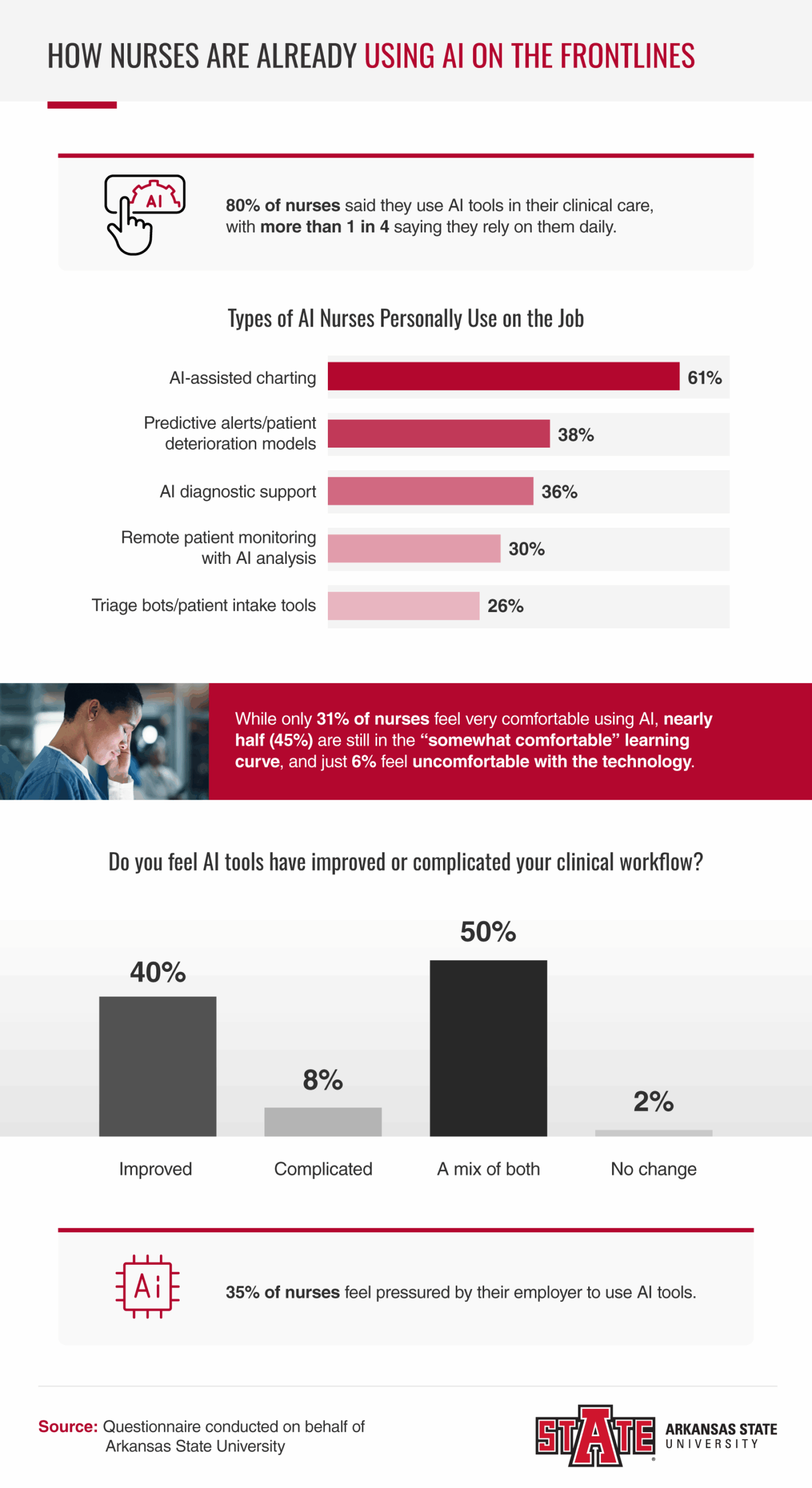
Artificial intelligence technologies are rapidly becoming part of daily nursing care and clinical decision-making. Eight in 10 nurses reported using AI tools in patient care, with more than one in four doing so every day.
The most common AI applications include charting in electronic health records (61%), predictive alerts or patient deterioration models (38%) and diagnostic support (36%). These tools help streamline workflows, reduce workload and improve real-time clinical decision support.
When asked how they learned to use AI systems, nurses reported varied experiences. Nearly half (48%) received formal employer-led instruction, 23% relied on on-the-job trial and error, and 19% learned through peer-to-peer collaboration. Only 6% received training directly from vendors, while 3% had no training at all. This uneven preparation underscores the need for structured competencies in nursing education to support the safe and effective integration of AI.
The impact of AI on nursing workflows is nuanced. Forty percent of nurses said AI tools improved their efficiency, while 50% experienced a mix of benefits and challenges. Just 8% said these technologies complicated their clinical practice. Comfort levels mirrored these findings: 31% felt very comfortable using AI, 45% somewhat comfortable and 6% uncomfortable.
Over one-third of nurses (35%) said they felt pressured by their employers to use AI-driven systems. There was also concern about the future of the profession. While 42% of respondents were worried that AI could replace parts of their role, 56% were not concerned. As healthcare organizations increasingly rely on digital health technologies and automation, ensuring adequate support and ethical implementation is critical to maintaining patient trust and provider well-being.
Navigating Ethical and Legal Gaps in AI Adoption
The rapid adoption of artificial intelligence in healthcare has created new ethical concerns, particularly regarding patient safety, data privacy and accountability. In this study, 63% of nurses cited patient harm as their top concern, followed by privacy breaches (51%) and lack of legal protection for providers (49%).
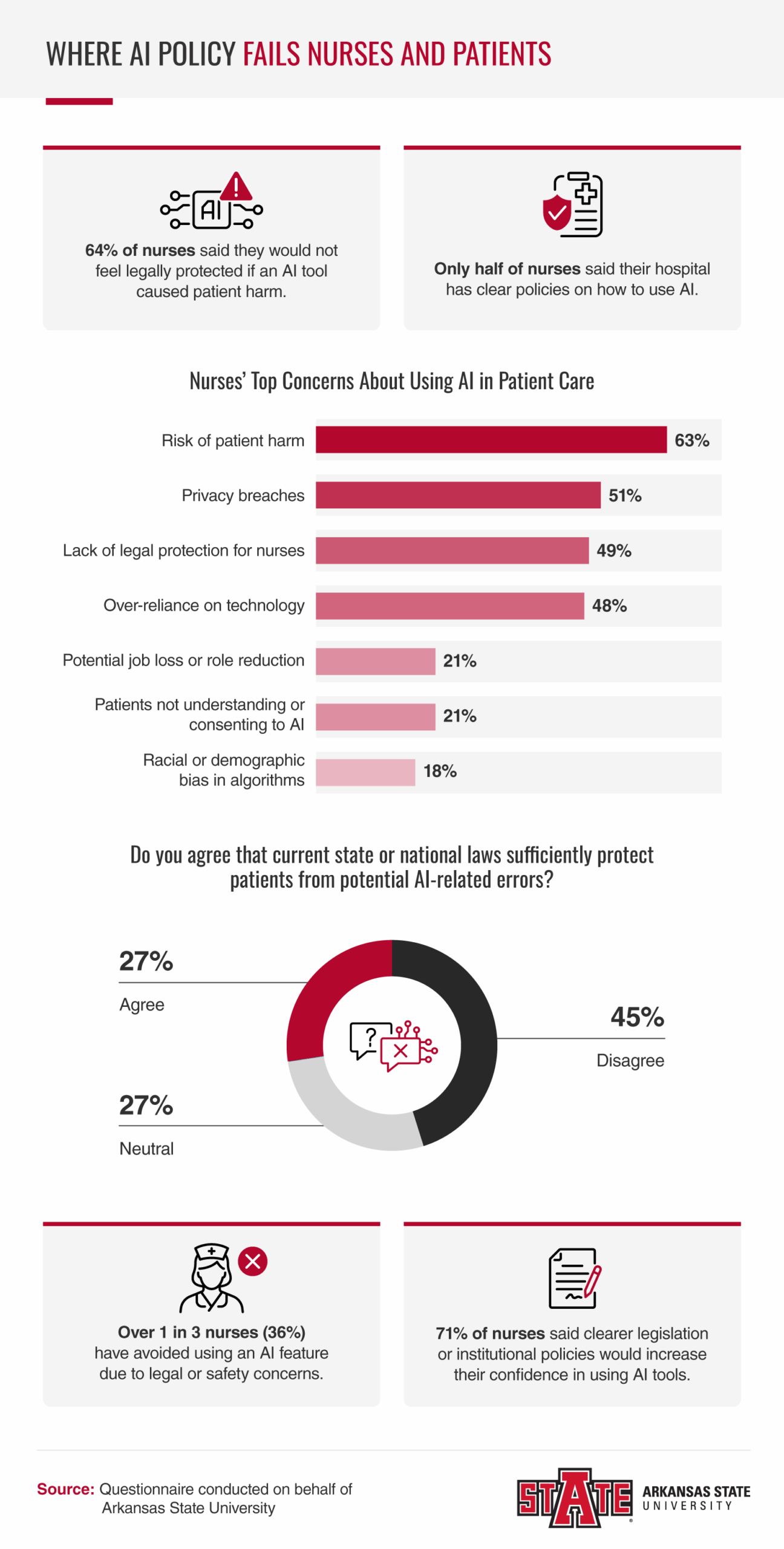
Only half of participants said their hospital has clear institutional guidelines on the use of artificial intelligence technology. Sixty-four percent reported they would not feel legally protected if an AI system contributed to patient harm. Just 27% agreed that current state or national laws adequately protect patients, while 45% disagreed and another 27% remained neutral.
The findings reflect a growing consensus among clinicians and policymakers that updated health policy and governance frameworks are needed to ensure the safe integration of AI in healthcare settings. Seventy-one percent of nurses said clearer legislation or institutional standards would boost their confidence in using AI applications for patient care.
To bridge these gaps, healthcare providers and policymakers must collaborate to establish transparent accountability systems that safeguard patient interactions and prevent inequities or unintended harm caused by automated or machine learning systems. Yet, as the use of artificial intelligence in healthcare expands, legal protections and institutional policies have not kept pace. This misalignment poses a serious challenge to safe patient care, informed clinical decision-making and the ethical use of technology in nursing practice.
Preparing Nurse Educators to Lead Ethical AI Integration
Nurse educators can play a vital role in helping the nursing profession adopt artificial intelligence responsibly. As AI becomes more common in clinical and educational settings, educators can guide future nurses in understanding both its potential and its limits.
Champion Ethical AI Practice
Ethical and safe use of AI begins with education. Nurse leaders and faculty can:
- Include data integrity, algorithmic bias and patient confidentiality in the curriculum
- Teach students how to evaluate AI systems critically and identify their strengths and weaknesses
- Emphasize that automation should enhance, not replace, human judgment in clinical care
- Encourage use of evidence-based practices when integrating AI into nursing workflows.
Educators can find helpful insights in “Ethical Concerns Regarding Integrating AI in Nursing Education” and this supporting research article on AI applications in nursing.
Establish Clear Institutional Guidelines
Collaboration is essential to developing unified policies for AI adoption across clinical and educational contexts. Educators can:
- Partner with academic institutions, accreditors and healthcare organizations to align standards for AI use
- Support policies that promote transparency and accountability in AI decision-making
- Integrate discussions of robotics, digital health systems and automation into existing courses
These efforts help maintain compassion and accountability in nursing practice. To explore best practices, review the NLN vision statement on AI in Nursing Education.
Support Ongoing Professional Development
The use of AI in healthcare will continue to evolve, so professional growth is essential. Nurse educators can:
- Offer workshops, micro-credentials and continuing education on AI ethics, informatics and public health
- Stay current on emerging AI technologies such as generative AI, natural language processing and chatbots
- Model responsible and ethical technology use in both teaching and practice
To help prepare for these rapid changes, many educators are turning to flexible online programs that support career advancement and lifelong learning. Arkansas State University’s online nursing degree programs and certificates offer pathways for nurses to expand their expertise while adapting to new technologies shaping the future of healthcare.
Guiding Nursing Students Toward Responsible AI Use
For nursing students preparing to enter today’s data-driven healthcare system, understanding artificial intelligence in nursing is now part of core competency development. Students should explore coursework that integrates informatics, clinical decision support systems and evidence-based technology assessments.
Hands-on exposure to AI-powered tools, such as telehealth triage platforms, robotics-assisted interventions or clinical chatbots, can deepen understanding of how digital health technologies enhance patient outcomes and provider workflows. Nursing students should also learn to identify disparities and inequities that may arise from biased algorithms or incomplete datasets.
Staying informed about health technology advancements and participating in interdisciplinary projects with data scientists, policymakers and clinicians can position nursing students to lead future directions in ethical AI integration. By developing both technical fluency and empathy, they can help shape an equitable, safe and human-centered healthcare environment.
Advancing the Nursing Profession in the Age of Artificial Intelligence
Artificial intelligence in healthcare offers powerful tools to enhance efficiency, streamline workflows and improve patient outcomes, but it also raises complex questions about accountability, ethics and education. This study reveals that nurses are embracing AI systems with cautious optimism, emphasizing the importance of patient safety, informed oversight and continual learning.
As the nursing workforce adapts to this new era of technological advancements, collaboration among educators, healthcare providers and policymakers will be essential. By aligning nursing education with responsible AI adoption, the profession can ensure that artificial intelligence serves as a partner in compassionate, evidence-based care.
Methodology
A questionnaire of 135 nurses was conducted on behalf of A-State in October 2025 to examine the integration of AI technologies into healthcare settings and the policy challenges that accompany this shift. This non-scientific, exploratory study gathered qualitative insights from healthcare professionals and incorporated recent market research to develop best practices for responsible AI adoption in nursing education and clinical environments.
About Arkansas State University
Arkansas State University offers a fully online Registered Nurse to Bachelor of Science in Nursing (RN to BSN) program, designed for working healthcare professionals who want to advance their nursing careers. The program emphasizes evidence-based practice, leadership and the integration of AI in patient care, preparing graduates to excel in a data-driven healthcare landscape that blends compassion, technology and innovation.
Fair Use Statement
Information from this article may be shared for noncommercial purposes only. If you use or reference these findings, please include proper attribution and a link to Arkansas State University.