


What if you could get back nearly a full workday every week? For college professors using ChatGPT and other generative AI platforms, that’s becoming a reality. Faculty are discovering that artificial intelligence can do more than automate tasks. It’s giving them something far more valuable: time to focus on student engagement and meaningful learning experiences.
The findings below are from a questionnaire conducted on behalf of Arkansas State University (A-State) that focused on college professors already using AI for teaching-related work. The questionnaire captured insights from educators across higher education to understand how these generative AI tools are influencing workload, confidence and burnout in daily academic life.
Key Takeaways
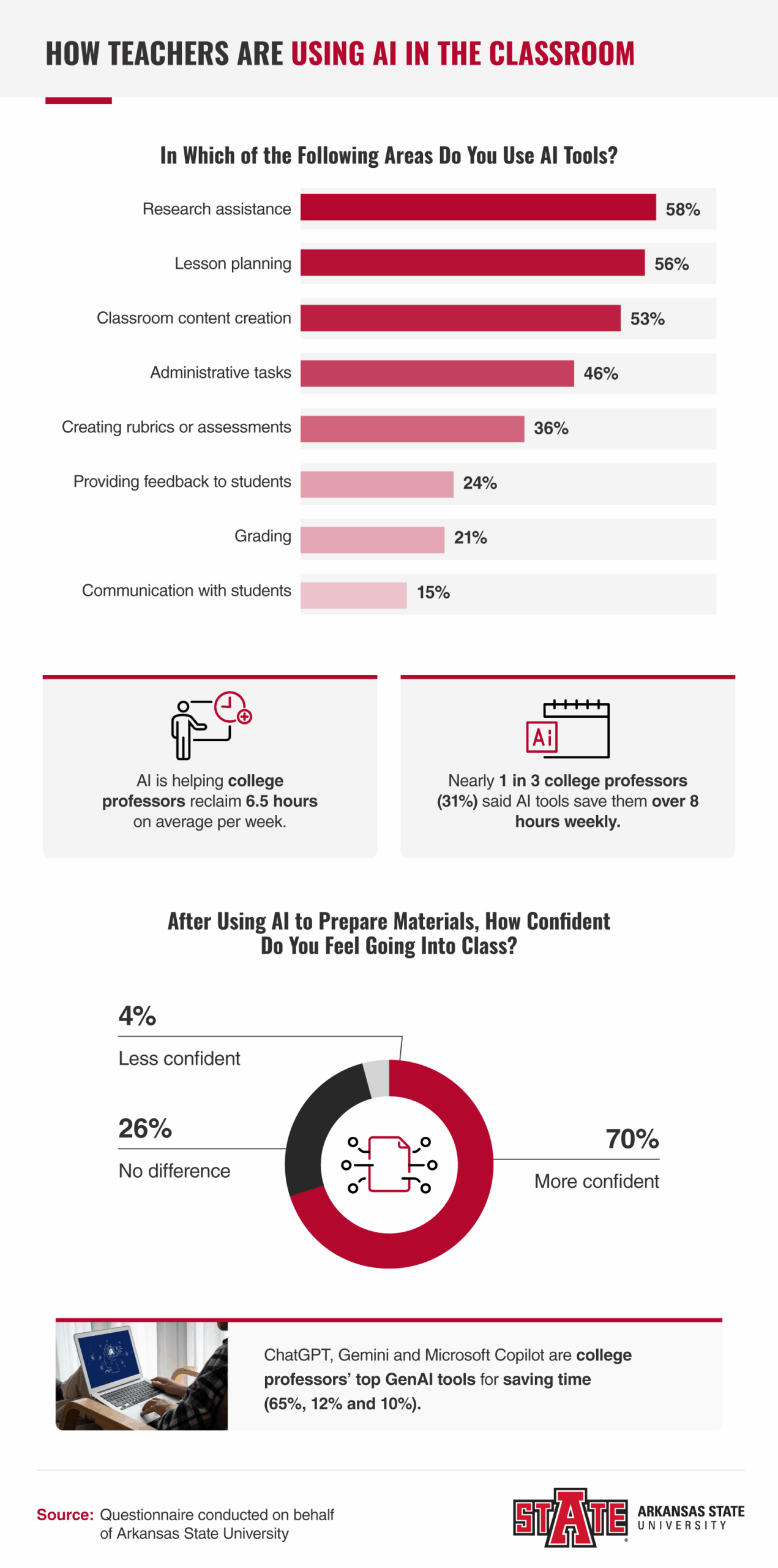
- AI is helping college professors reclaim 6.5 hours per week on average.
- 70% of college professors feel more confident going into class after using AI to prepare materials.
- 74% of college professors feel less burned out since incorporating AI into their work.
- 70% of college professors say AI tools help them feel more in control of their workload.
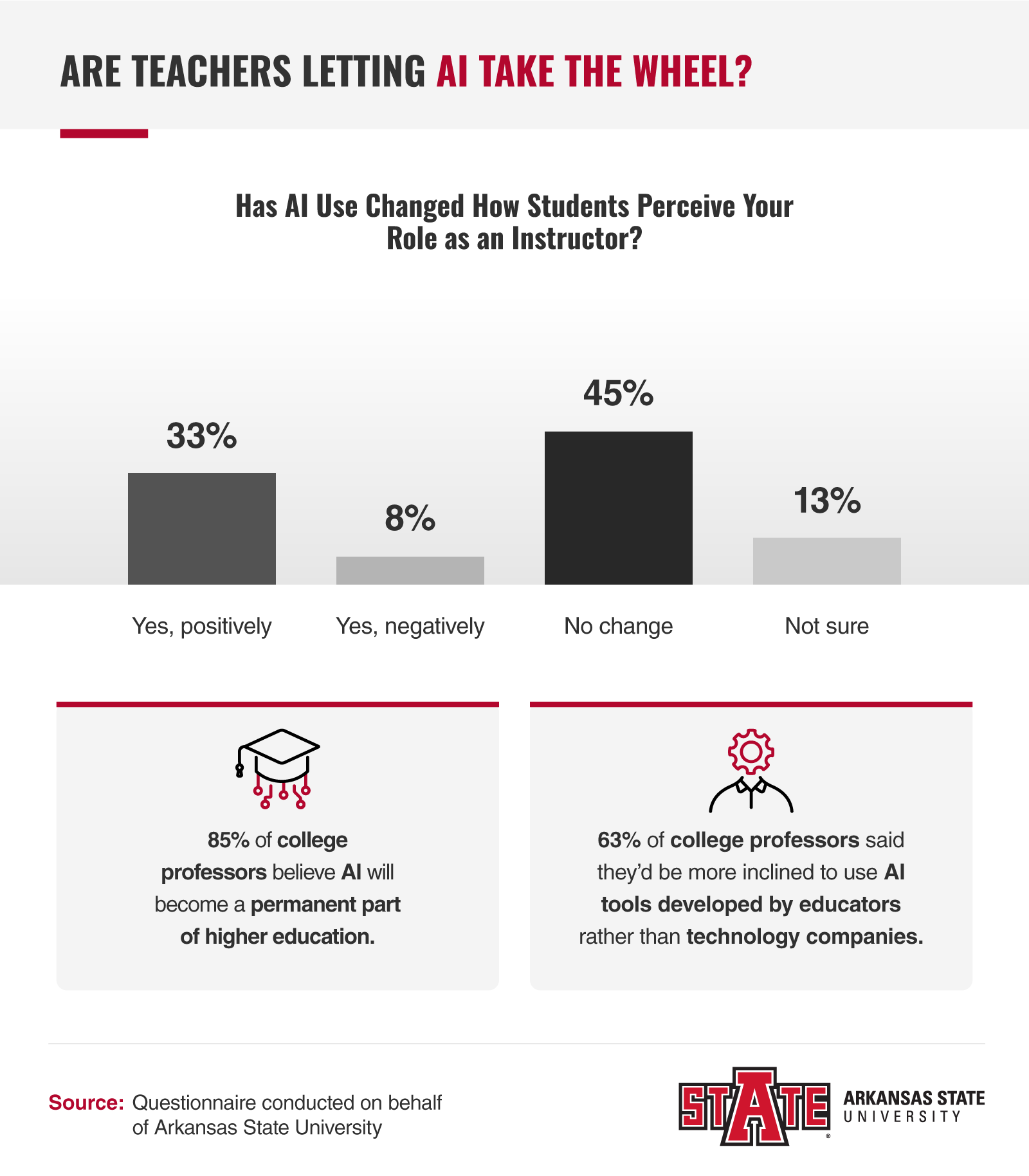
- 85% of college professors believe AI will become a permanent part of higher education.
Where AI Tools Help Educators Most
The numbers tell a clear story: artificial intelligence gives professors their time back. College professors reported reclaiming an average of 6.5 hours per week through the use of AI. That’s nearly an entire workday returned to faculty control every single week.
The AI-powered tools college professors used delivered different levels of impact:
- Gemini users reported the highest average time savings at 7.9 hours per week, totaling 410.8 hours per year.
- Microsoft Copilot users saved 6.6 hours per week (343.2 hours annually), followed by ChatGPT at 6.2 hours per week (322.4 hours per year).
- Perplexity users reported saving 5.4 hours per week, or 280.8 hours annually.
Time wasn’t the only gain. Seventy percent of professors said they felt more confident walking into class after using AI to develop lesson plans, assignments or supporting materials. For faculty juggling multiple sections and competing priorities, that boost in preparation quality matters as much as the hours saved.
These AI-assisted teaching practices are allowing educators to enhance course design and improve learning outcomes. Professors are reinvesting the time AI saves in ways that strengthen both their professional work and personal well-being. They reported using their freed-up hours for:
- Preparing future course materials (54%)
- Research or professional development (43%)
- Personal time or rest (43%)
- Administrative work (42%)
- Student communication or meetings (32%)
AI and Teacher Burnout in Higher Ed
Burnout in higher education has been studied extensively. Solutions have been harder to find. AI in education appears to be offering something that actually works.
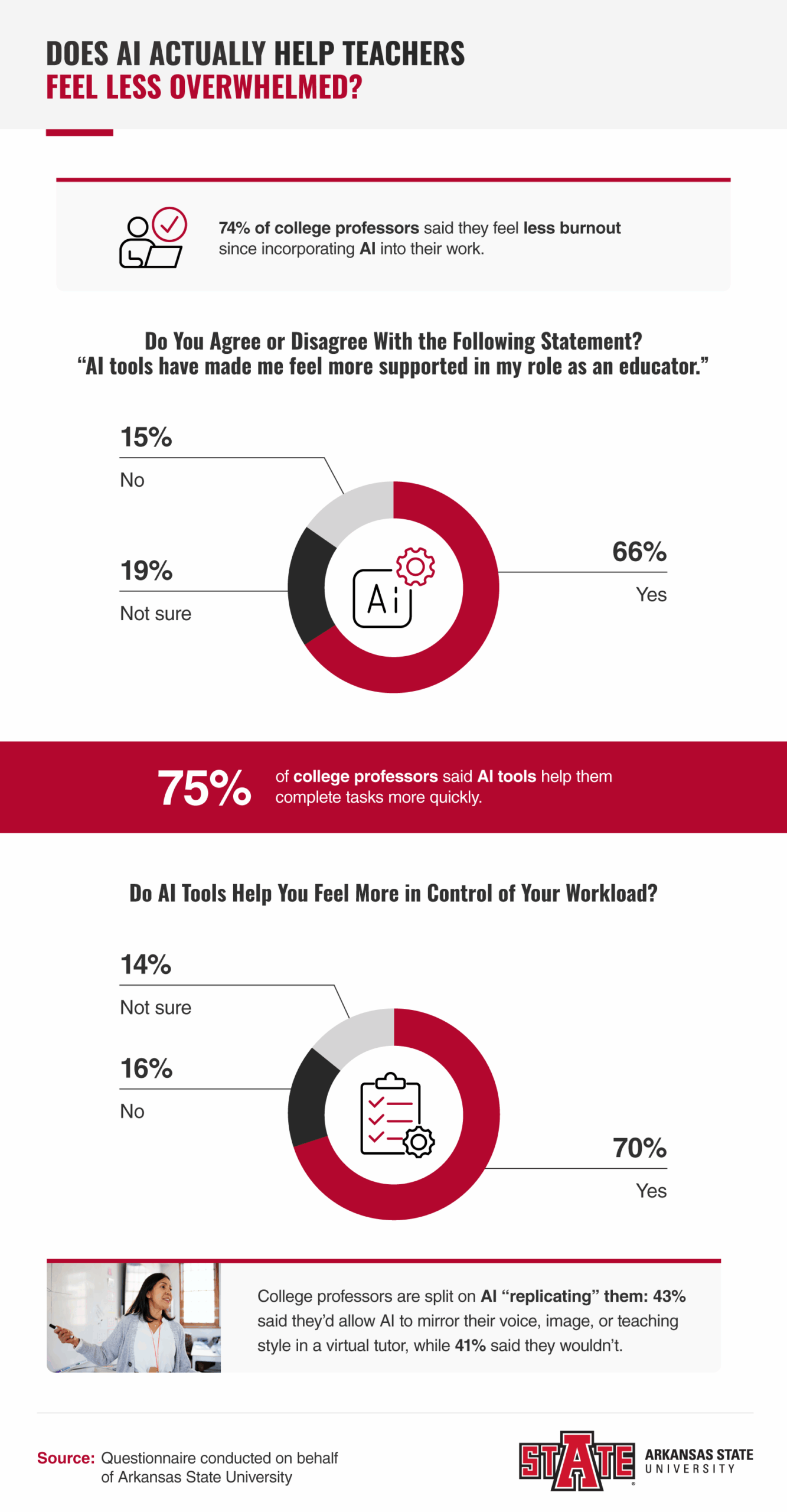
But the transition to teaching with AI hasn’t been frictionless, as 46% of professors acknowledged that these new technologies introduced new complexities into their workday. Yet, faculty remain open to deeper engagement.
More than half (59%) said they would be willing to contribute their own instructional materials or teaching methods to help train AI tools designed specifically for education. Their knowledge would act as a practical guide to improve large language models (LLMs) built for academic use.
Is AI Changing the Teacher-Student Relationship?
Looking to the future of education, 85% of college professors agreed that AI will become a permanent part of higher ed. However, that doesn’t mean they’re ready to use it everywhere. Professors are carefully considering where and how it fits into student-facing activities.
- Grading (56%)
- Feedback (50%)
- Student advising and counseling (47%)
The concern isn’t about the capability of AI chatbots or generative AI tools. It’s about preserving the relationship-building, human learning connections and nuanced judgment that define effective teaching practices. Many faculty recognize that while GenAI can support brainstorming and problem-solving in course content development, the learning process itself requires authentic human interaction.
What professors want instead is better alignment. A majority (65%) said they would prefer their institution provide AI tools tailored to their curriculum, policies, and teaching needs rather than relying on general-purpose platforms developed by OpenAI and other providers.
The preference reflects a practical reality. Generic LLMs can’t understand the specific context of a particular course, department or institutional culture. Educators seek AI-assisted enhancement of their teaching, not replacement of the real-world connections they build with learners.
Moving Forward with AI in Higher Ed
AI isn’t replacing professors. It’s returning something they’ve been missing for years: control over their time and energy. The findings suggest faculty are using AI-powered tools strategically to reduce low-value work, prepare more thoroughly and protect themselves from burnout. The results are measurable. Professors are feeling more confident walking into class, better workload management and less exhaustion.
Challenges remain, as generative AI tools can introduce new friction points, and not all institutions have yet figured out how to support faculty through the transition. Questions about appropriate use in student-facing contexts, maintaining academic integrity and fostering critical thinking and student learning are still being worked out. But as colleges continue exploring responsible AI integration, the faculty voice should matter.
Professors are the ones figuring out what works, what doesn’t and where the boundaries should be, and their experiences will shape how higher education uses these tools moving forward. This ongoing exploration represents not just an enhancement of teaching practices but a fundamental rethinking of how AI literacy and student engagement intersect in the modern classroom.
Methodology
This study was administered to 336 college professors on behalf of Arkansas State University to explore how they use artificial intelligence (AI) tools in their teaching and professional responsibilities. To participate, respondents had to report using AI tools for teaching-related tasks. Data was collected in January 2026. The findings reflect a non-scientific, exploratory study and are not intended to be nationally representative of all college professors.
About Arkansas State University
Arkansas State University offers flexible online programs designed for educators seeking to advance their careers in higher education. The online Master of Science in Higher Education program focuses on leadership, student development and the operational challenges colleges face today. The program is built for working professionals who want practical skills they can apply directly to academic and administrative roles.
Fair Use Statement
The information in this article may be used for noncommercial purposes only. If shared or cited, you must include proper attribution and a link back to Arkansas State University.