


Artificial intelligence (AI) is rapidly transforming how college students navigate their academic journeys. From course selection to registration troubleshooting, AI tools like ChatGPT and Google Gemini have become trusted companions for many. However, as these tools become more prevalent in higher education, questions arise about their reliability and their influence on students’ decision-making.
To explore this growing trend, a questionnaire conducted on behalf of Arkansas State University (A-State) polled 412 current college students across the U.S. who reported using AI for academic or administrative support. The questionnaire examined when students turn to AI, how much they trust its responses and where human advisors remain indispensable. The following findings indicate a generation eager to adopt digital solutions, yet still aware of the limitations of automation in achieving academic success.
Key Takeaways
- Nearly one in four college students (22%) use AI tools every day for academic or administrative help.
- More than half of college students (51%) rely on AI more than Google for quick academic help.
- Nearly one in five college students (19%) trust AI tools more than their school’s official website when seeking academic or administrative help.
- 41% of college students have followed AI advice that turned out to be incorrect.
- 32% of college students would feel confident making major academic decisions based solely on AI advice.
- 59% of college students value the accuracy of a human advisor over the speed of AI when making high-stakes academic decisions, while only 6% prioritize AI’s speed.
- 41% of students believe AI won’t ever fully replace human advisors.
AI as the First Stop for Quick Academic Answers
As AI tools become more accessible and intuitive, students are turning to them for instant answers to academic questions. Whether clarifying a policy or creating a class schedule, these systems now play an active role in how students manage their college experience.
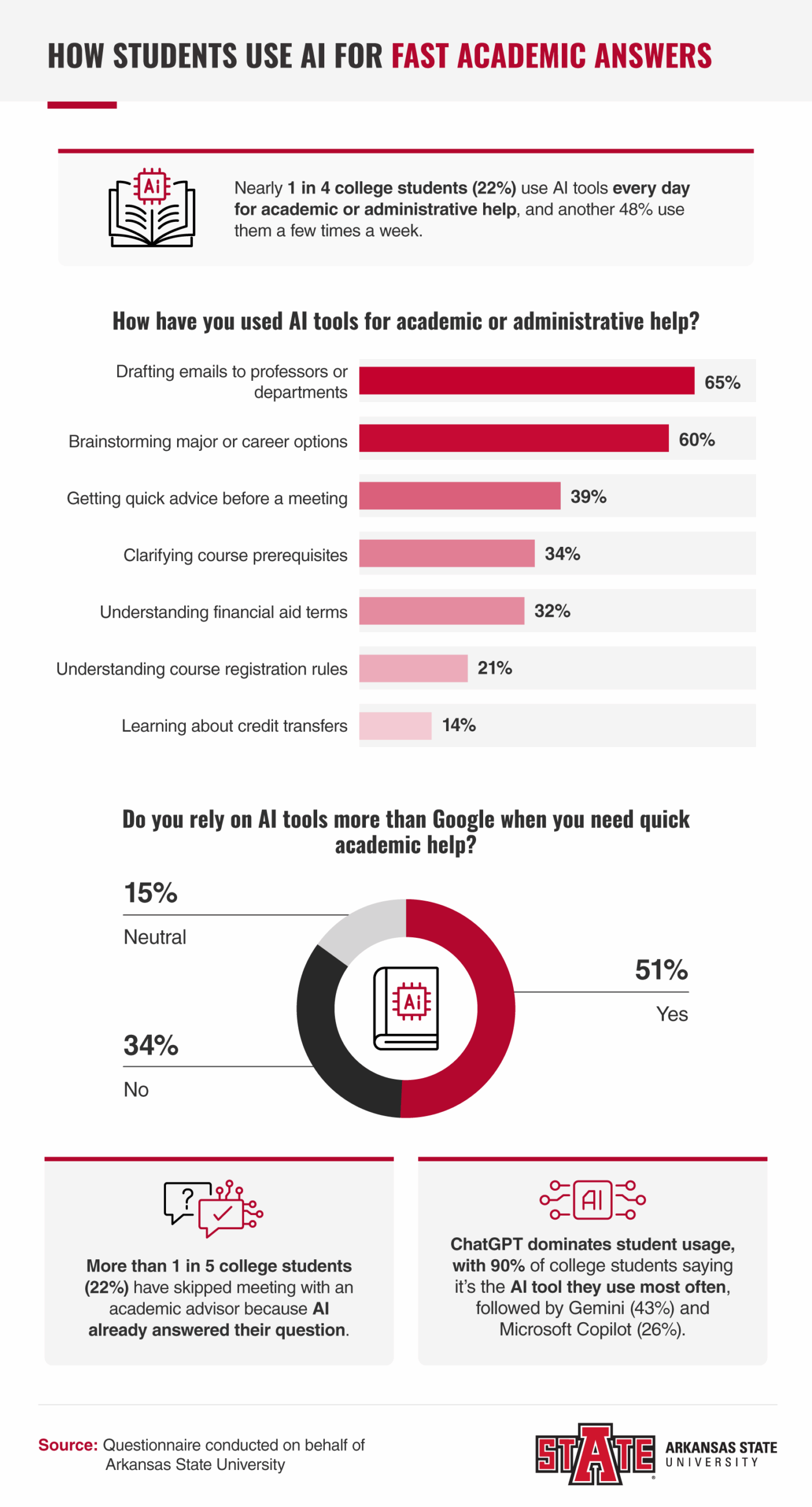
More than half of college students (51%) said they rely on AI more than Google when seeking quick academic help. Nearly one in four (22%) reported using AI tools every day for academic or administrative support. AI has become a regular utility for some students, comparable to search engines or messaging apps, for managing college life.
Still, trust varies by context. While nearly one in five students (19%) said they trust AI more than their school’s official website when searching for academic or administrative help, the majority (62%) continue to rely on their institution’s own sources. Another 19% remain unsure, indicating an ongoing shift in trust that higher education leaders will need to monitor closely.
The Risks of Relying Only on AI for Academic Guidance
While AI can deliver quick and convenient answers, students often face challenges when using it for complex academic decisions. About four in 10 college students (41%) said they have followed AI advice that turned out to be incorrect.
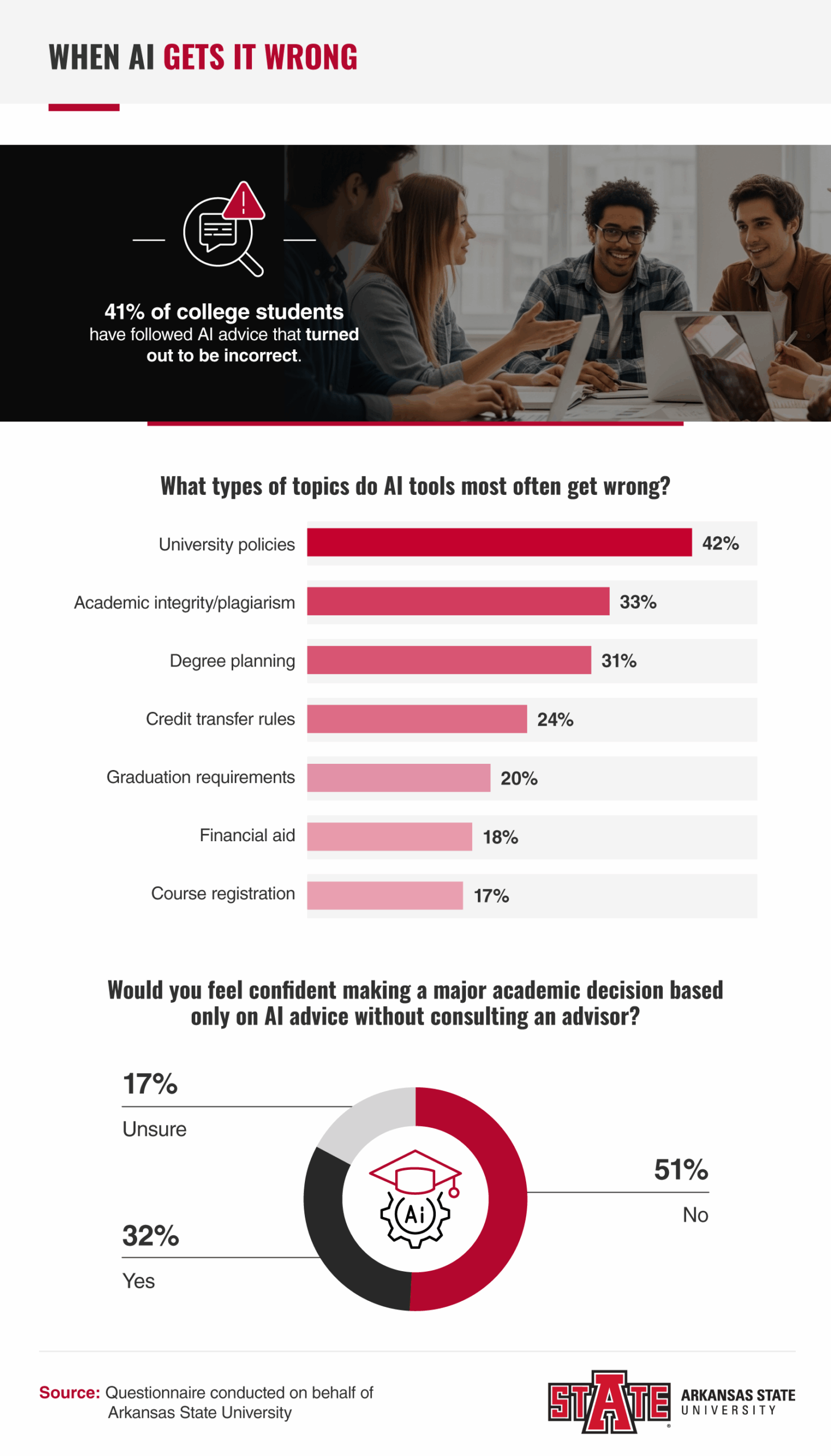
Among the students who received incorrect information from an AI tool, 74% said the misinformation wasted their time. Another 7% missed deadlines, and 6% enrolled in the wrong class as a result. These findings highlight the potential academic consequences of depending too heavily on unverified information.
When asked if an academic advisor had corrected the bad advice they received from an AI tool, 66% of these students reported that they had not. This points to a growing need for stronger connections between human advising systems and the digital tools students increasingly rely on.
Even as 32% of students said they would feel confident relying solely on AI for major decisions, the combined 68% who were either unsure or not confident illustrate that most students still value human insight as an essential part of academic advising.
Students Still Trust Advisors Most
Even as AI becomes more powerful, most students still recognize the irreplaceable value of human advisors. Their expertise and empathy provide a level of understanding that technology alone cannot replicate.
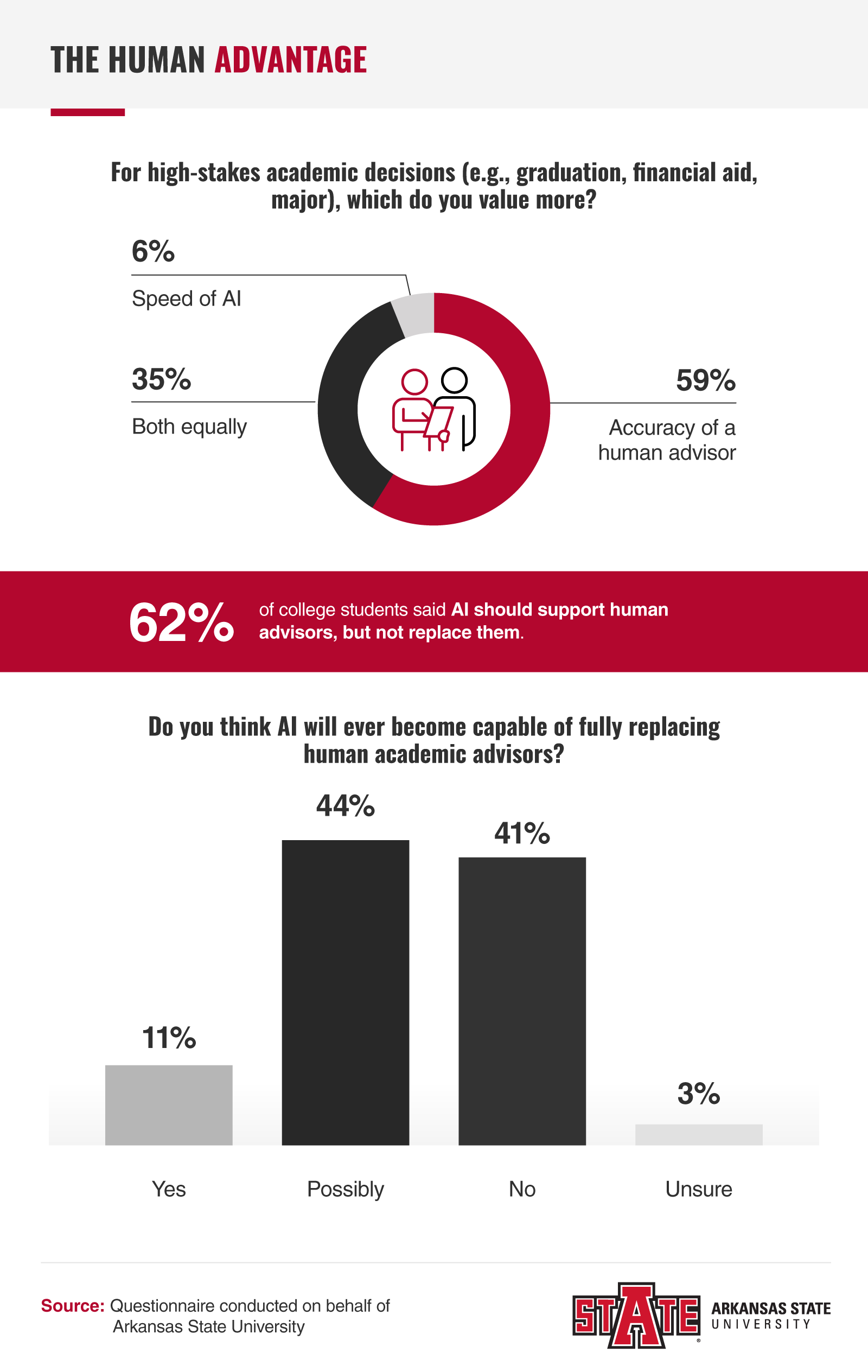
When making high-stakes decisions, 59% of college students said they value the accuracy of human advisors more than the speed of AI. Only 6% said they prioritize AI’s efficiency over expert human input, while 35% valued both equally. Furthermore, 41% of students do not believe AI will ever fully replace human advisors.
Reasons Why Students Believe AI May One Day Fully Replace Human Advisors
- AI is available 24/7: 88%
- AI gives faster responses than advisors: 69%
- AI reduces the need to wait for appointments: 65%
- AI can handle routine or repetitive advising questions: 62%
- AI is improving quickly and will eventually outperform humans: 53%
Reasons Why Students Believe AI Won’t One Day Fully Replace Human Advisors
- Advisors can offer mentorship, not just information: 73%
- Some situations are too complex or emotional for AI: 70%
- Advisors understand context and nuance better than AI: 69%
- AI can give incorrect or outdated information: 68%
- Students still need personal connection and support: 65%
These responses reveal that students see AI as a useful complement, but not a substitute for the empathy, context and guidance only human advisors can provide.
Still, many students may turn to AI privately when they feel uncertain or hesitant to ask for clarification. Nearly one in three (30%) said they have used AI to better understand school policies after initially indicating they understood them. Easily accessible AI tools can fill knowledge gaps, but it is important for advisors and institutions to also create open, judgment-free spaces where students feel comfortable seeking direct guidance.
Balancing AI Efficiency With Human Insight
Artificial intelligence is becoming a meaningful part of how many students plan and manage their academic paths. For colleges and universities, the findings point to an opportunity rather than a challenge.
By integrating AI into advising systems with care, schools can expand access and support without losing the personal connection that defines effective guidance. The future of advising will be strongest where technology enhances the human touch.
Methodology
A questionnaire was administered to 412 current college students across the U.S. on behalf of Arkansas State University to explore how students are using AI as a supplemental advising resource. All respondents confirmed that they have used AI tools like ChatGPT, Gemini or others for help with academic or administrative tasks. Data was collected in October 2025. This is a non-scientific, exploratory study and is not intended to represent all college students.
About Arkansas State University
Arkansas State University offers flexible, fully online degree programs designed for working adults seeking to advance their education. Students can explore programs such as the online Master of Science in Education (MSE) in Educational Leadership, which prepares educators for administrative roles through innovative coursework and applied leadership experience.
Fair Use Statement
Information from this article may be shared for noncommercial purposes only. When citing or redistributing the content, please include a link back to A-State with proper attribution.