


As artificial intelligence and automation change the skills employers need, professionals are reevaluating the purpose and return on investment of graduate education. A recent questionnaire conducted on behalf of Arkansas State University (A-State) asked 1,002 employed Americans with at least a bachelor’s degree to share their views on how AI is influencing graduate degree choices and career preparedness.
This research aimed to gain a deeper understanding of how working adults perceive the value of advanced education in an AI-first economy. The findings highlight a clear shift in mindset, as many professionals see specialized programs in data science, AI and related disciplines as better suited to the demands of a rapidly evolving workplace. The results reveal important differences across industries and generations, offering insight into how education can future-proof careers.
Key Takeaways
- 70% of professionals believe that specialized master’s degrees will be the most valuable in the future, while 12% think MBA programs will be.
- 58% of respondents say that a master’s degree in data science or AI best prepares them for an AI-driven workplace, compared to 28% who say an MBA is best suited for this purpose.
- Nearly one in three professionals (31%) believe earning a graduate degree would help safeguard their career from being disrupted by AI or automation.
- 44% of professionals expect to need training in AI ethics and policy soon, making this the top emerging skill gap.
What Prepares Professionals for an AI-Driven Future?
As AI adoption grows, professionals are reassessing the skills and degrees needed to stay competitive. While MBA degrees have long been crucial for advancement, new data suggests more workers now prioritize technical specialization to excel in an AI-driven economy.
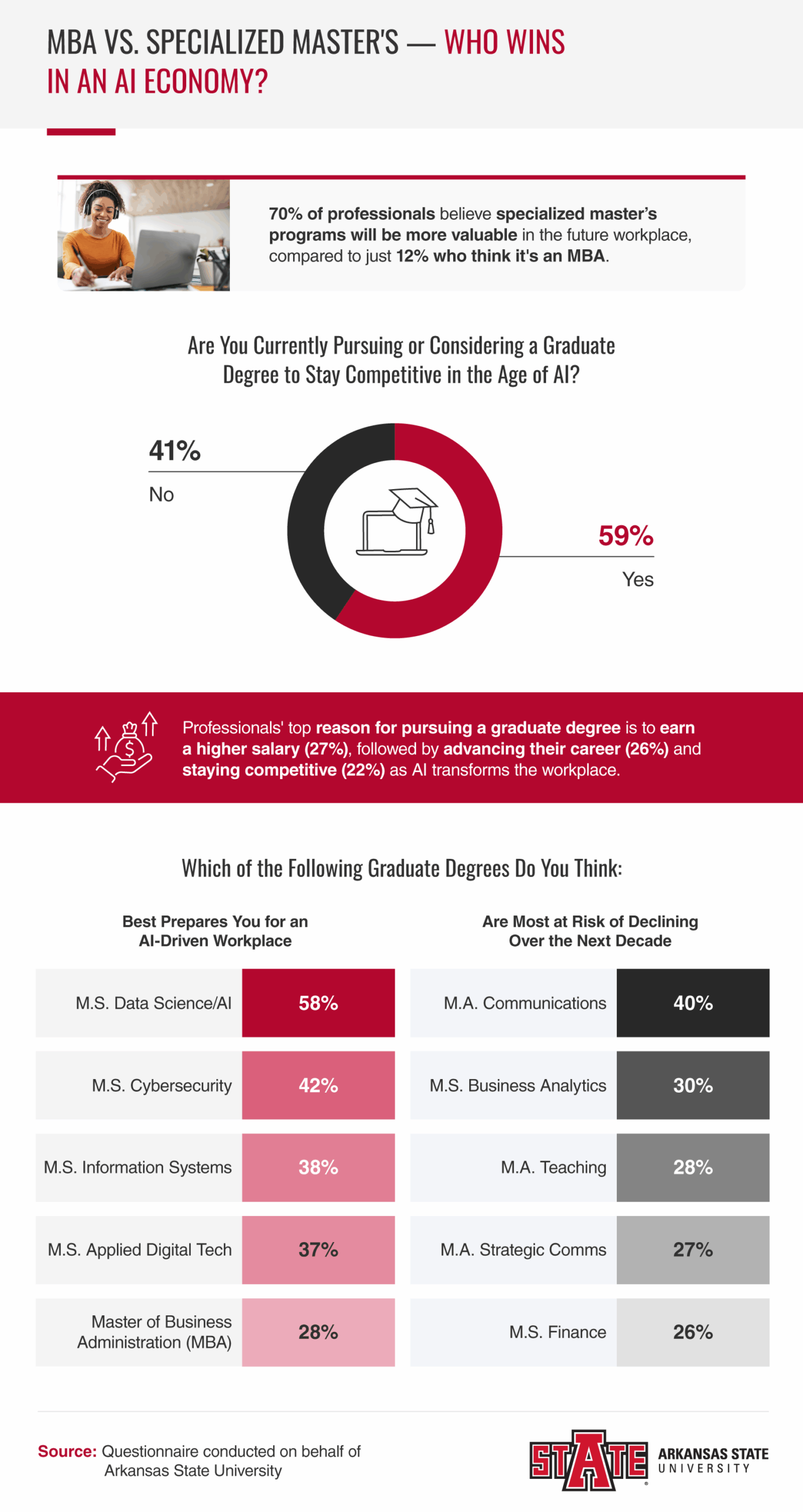
Seventy percent of respondents said specialized master’s programs will hold greater value in the future workplace, compared to just 12% who selected the MBA. Among degree options, the master’s in data science or AI, chosen by 58% of professionals, stood out as the most relevant to an AI-powered future. Respondents considered a master’s in cybersecurity (42%) as the next most helpful degree, followed by a master’s in information systems (38%), a master’s in applied digital technology (37%) and an MBA (28%).
Industry preferences also showed notable divides. Traditional business sectors continue to view the MBA as a strong credential for leadership and management roles, including finance and banking (21%), marketing and advertising (19%), and hospitality (18%). However, fields that are deeply integrated with technology tend to favor more technical degrees, with information technology (78%), government and public sector roles (74%), and healthcare (71%) leaning heavily toward specialized programs in data, analytics, or AI.
These findings suggest that while an MBA degree retains value in business-oriented fields, professionals in technology-driven industries increasingly prioritize degrees that offer applied expertise and direct exposure to emerging technologies.
Can a Graduate Degree Protect Your Career From AI Disruption?
Concerns about job security in the age of automation are influencing how professionals think about graduate education. Many view advanced degrees as a means to remain adaptable and potentially indispensable as AI transforms the workplace.
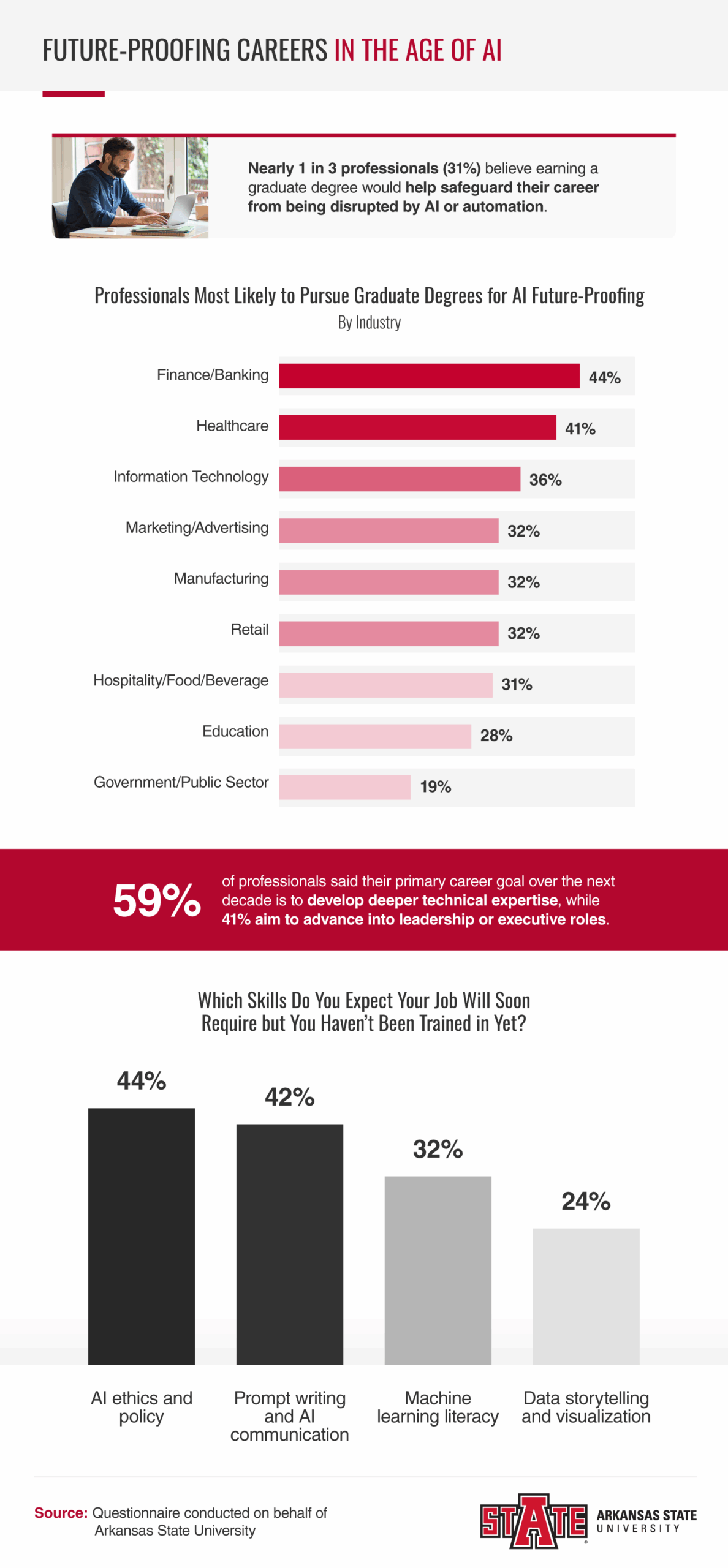
Nearly one in three professionals (31%) said earning a graduate degree could help safeguard their career from being disrupted by AI or automation. This belief was especially strong among Gen Z professionals (38%), who were more likely than older generations to view graduate study as career insurance. Millennials and baby boomers followed closely at 32%, while Gen X professionals were the least likely to share this view at 26%.
When asked which type of skill set will hold the most value in the long term, 41% said both technical and business skills will be equally valuable, while 37% prioritized specialized technical knowledge. Only 17% chose versatile business leadership skills, highlighting a broader shift toward technical fluency as the cornerstone of future leadership.
In addition to technical expertise, professionals also acknowledged new areas of competency they expect will be needed soon. Forty-four percent identified AI ethics and policy as a critical emerging skill gap. This finding points to growing awareness of the societal and regulatory challenges surrounding AI implementation and the need for leaders who can navigate them responsibly.
Adapting Graduate Education for an AI-driven Economy
Research conducted for A-State reveals a clear evolution in how professionals view the purpose of graduate education. While business leadership remains essential, the future increasingly belongs to those who can combine strategic insight with technical mastery.
For many, that means pursuing specialized degrees designed to meet the challenges of an AI-first economy. As industries continue to integrate intelligent technologies, lifelong learning and graduate study will remain vital tools for resilience and relevance in the modern workplace.
Methodology
A questionnaire was administered to 1,002 employed Americans on behalf of Arkansas State University to explore their perceptions of the value of graduate education. All participants held at least a bachelor’s degree. Data was collected in November 2025. This non-scientific, exploratory study is not intended to represent all college students.
About Arkansas State University
Arkansas State University provides flexible, fully online degree programs to prepare professionals for today’s technology-driven world. A-State’s online Master of Science in Applied Digital Technology – General program equips students with the technical and analytical skills needed to lead digital transformation in diverse industries. Through this program, students develop expertise in AI development and cybersecurity, enabling them to stay competitive in the digital economy.
For professionals seeking to blend business leadership with specialized knowledge, A-State offers online MBA concentration options that combine strategic management training with focused expertise in high-demand areas. This approach allows students to develop both the versatile leadership skills valued across industries and the technical fluency increasingly required in today’s AI-driven workplace, positioning graduates to lead confidently at the intersection of business strategy and emerging technology.
Fair Use Statement
Information from this article may be shared for noncommercial purposes only. Please include proper attribution and a link back to Arkansas State University when citing or referencing this material.