

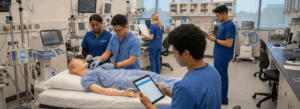
Accelerated nursing programs give students with a non-nursing bachelor’s degree a faster route to becoming a registered nurse. These intensive degree paths — including the hybrid Accelerated Bachelor of Science in Nursing (ABSN) program at Arkansas State University (A-State) — condense nursing education into a 12 to 18-month timeline, helping students enter the healthcare field sooner.
A-State offers a hybrid ABSN program that combines online coursework with required on-campus labs in Jonesboro, Arkansas. Due to this in-person component, the program may be best for students who live in or can relocate to Arkansas. It is designed for adult learners and career changers who are ready to pivot into nursing through an accredited, fast-track BSN.
There are multiple start dates, and qualified students may also be eligible for financial aid, helping reduce the cost of this full-time degree program. This article outlines how accelerated BSN programs work, what A-State’s ABSN offers, and what to expect from admissions requirements, prerequisite courses and clinical training.
It also compares the ABSN to traditional BSN programs, so prospective students can decide which path is right for them. Accredited accelerated nursing programs like A-State’s offer a focused and efficient path into patient care careers — without starting a bachelor’s degree from scratch.
What Is an Accelerated Nursing Program?
Accelerated nursing programs are fast-track pathways that allow individuals with a non-nursing baccalaureate degree to pursue licensure as a registered nurse. These programs condense a traditional four-year nursing degree into an intensive format that requires full-time commitment and a structured curriculum.
A-State’s Accelerated BSN program is accredited by the Accreditation Commission for Education in Nursing (ACEN) and follows a hybrid learning model. Students complete online coursework at their own pace, attend labs on campus in Jonesboro, Arkansas, and participate in in-person clinical experiences arranged by the program. These clinical hours in various healthcare settings provide students with valuable hands-on experience and help them develop strong patient care and professional nursing skills.
In addition to academic preparation, the ABSN program supports students through clinical placement and offers financial aid and scholarship opportunities to those who qualify. For many adult learners, this type of nursing degree provides an efficient way to transition into a high-demand field while maintaining educational quality and licensure-readiness.
Traditional BSN vs. Accelerated BSN: What’s the Difference?
When you examine nursing education options, the key difference between a traditional BSN program and an accelerated BSN program is time‑to‑completion. Traditional BSN programs typically span four years, with a mix of general education and nursing‑specific coursework.
In contrast, accelerated BSN programs (also known as “fast‑track BSN” or second‑degree BSN programs) allow individuals who already hold a non‑nursing bachelor’s degree to earn their nursing degree in about 12 to 18 months through intensive full‑time study. The program duration for A-state’s ABSN is 15 months.
Both pathways ultimately prepare students to take the NCLEX‑RN and become licensed registered nurses (RNs). However, the structure, pace, admissions criteria and learning experience differ significantly.
| Traditional BSN vs. Accelerated BSN | ||
| Category | Traditional BSN | Accelerated BSN |
| Program length | Typically four years | 12-18 months full-time |
| Structure and coursework | Includes general education and nursing courses, with a more flexible pace | Condensed format focused solely on nursing courses, with minimal breaks |
| Admissions requirements | High school diploma or equivalent; minimal prerequisites | Non-nursing bachelor’s degree, 3.0+ GPA and prerequisite science courses |
| Clinical hours | Standard clinical placement throughout program | Equivalent clinical hours in compressed timeline |
| Outcomes | Prepares graduates for RN licensure via NCLEX | Same NCLEX licensure eligibility |
| Cost and financial aid | May cost more in total due to longer timeline; standard aid available | May cost less overall; aid may be limited due to second-degree status |
What Are the Admission Requirements and Prerequisites?
Admission to an accelerated BSN program is intentionally selective. Most schools expect a non-nursing bachelor’s degree and a GPA of 3.0 or higher to show you can handle intensive nursing coursework. In addition to academic performance, applicants must complete a series of science-based prerequisite courses before enrollment.
When you apply to an accelerated BSN program, you’ll have to send in your college transcripts, show that you meet the requirements for clinical placements and fill out the necessary forms. Deadlines change depending on when the program starts, so it’s smart to submit everything early to hold your spot. Most schools ask for a few standard items, such as:
- A non-nursing bachelor’s degree
- Minimum GPA (typically 3.0 or higher)
- Prerequisite courses on topics such as microbiology, physiology, statistics and mental health
- Official college transcripts
- Background check and drug screening
- Proof of immunizations
- Completed application form and application fee
These criteria help ensure students are academically prepared and meet clinical eligibility standards. This is a key factor for clinical placement during the BSN degree program.
What to Expect in an Accelerated BSN Program
Accelerated BSN programs are designed to deliver a full nursing education on a fast-paced timeline. Students are expected to complete the same nursing courses and clinical experiences as traditional BSN students, but in 12-18 months. This full-time structure requires consistent engagement across online coursework, in-person clinical rotations and on-campus lab training.
The Arkansas State University ABSN program blends flexible online learning with structured in-person components. Students complete clinical experiences and practicum hours under supervision to build real-world competencies in professional nursing. The program also emphasizes evidence-based instruction and hands-on training supported by A-State’s School of Nursing. Key components of an accelerated BSN program typically include:
- Foundational and advanced nursing courses in areas such as health promotion, mental health, pediatric care and evidence-based practice
- Clinical rotations across multiple specialties and settings
- On-campus simulation labs and skills assessments
- Faculty-led practicum experiences
- Support for clinical placement coordination
This rigorous yet efficient format prepares nursing students for licensure and a transition into patient care roles. It provides both the confidence and clinical competency that nurses need to succeed.
Note: Students must be able to attend labs and clinicals in person in Jonesboro, Arkansas, and should verify state authorization before applying to ensure eligibility.

Is an Accelerated Nursing Program Right for You?
Accelerated nursing programs work well for students who are ready to focus entirely on earning a fast-track BSN. If you already have a bachelor’s degree in another field and want to move into healthcare without starting over, an accelerated BSN — online or hybrid — can be a practical path. Some of the main benefits are:
- Faster degree completion in 12-18 months
- Opportunities to switch careers and enter a growing field
- Strong job outlook for registered nurses across clinical settings
However, these programs are intense. Nursing students should expect a heavy course load, a full-time schedule and strict requirements for clinical placement. Managing outside commitments may be challenging during the degree program.
For students pursuing a nursing career in Arkansas, A-State’s accelerated nursing program offers structured support. The College of Nursing pairs professional nursing coursework with a collaborative learning environment. Students benefit from experienced faculty and consistent academic guidance.
Take the Next Step Toward Your Nursing Career
Accelerated nursing programs provide a path for motivated students to transition into nursing more quickly than through traditional programs. A-State’s Accelerated BSN degree combines hands-on clinical work, challenging coursework and a focus on patient-centered care to help students become registered nurses in less time.
The program is accredited by the ACEN, affirming its commitment to educational quality and clinical competency. Whether you are changing careers or building on prior education, A-State delivers a clear route into nursing through its accelerated program. Explore A-State’s hybrid Accelerated BSN program to learn more about admission requirements, application deadlines, the application process and clinical placement details.